Wednesday, October 12, 2011

India music: Bollywood songs

There's a lot of Bollywood dance parties in our house, pretty much every night.  The Whirl Girl has loved Bollywood songs ever since she was a baby and now she can sing and dance along. 

Most of the music you hear on the radio comes from Bollywood movies, which are filled with song-and-dance numbers.  Here's three of our favorites.  You can watch them on YouTube to pick up a few new moves, or download on iTunes to get your groove on.

Bum Bum Bole
from the movie Taare Zameen Par, about an inspiring teacher set in a classroom full of kids

Maahi Ve
from the movie Kal Ho Na Ho, the ultimate wedding song and dance

Mitwa
from the movie Lagaan, a song about friendship set in an Indian village

(All three movies are recommended too for grown-ups and older kids). 


Tuesday, October 11, 2011

India crafts: Paper plate elephant

Time for some animal crafts!  We're venturing into the Indian jungle to make an elephant, a tiger and a peacock puppet out of paper plates, inspired by posts on Activity Village.  We tried to do all of them on a rainy morning, which I wouldn't really recommend.  The Whirl Girl loves her projects and even by the end of it, she was sick of them and ready to just play.  But individually, they shouldn't be too much work. 


First up, an elephant.  You can tell that she's Indian because she's all decorate like elephants in India often are.  Like this one (photo from National Geographic):


Supplies:
  • paper plate (we used a small one)
  • gray (or black and white) paint
  • gray paper
  • wooden chopstick or something similar
  • glue-on eyes or black paper
  • decorations (optional)

 Step One: Paint the plate gray.  

Step Two: Add decorations.  We cut out paper and ribbons that I had. 

Step Three: Glue on trunk and eyes. 


Step Four: Glue on ears.  The Whirl Girl decided these needed some decoration too, this time with crayons.


Step Five: Attach chopstick to the back to make it a puppet.

 Introduce to other Indian jungle friends.  

Diwali Tour of Singapore's Little India

Deepavali - or Diwali - is just around the corner.  Your kids may be learning about it in school, or at least know that it's a public holiday here in Singapore.

I had a couple of friends ask for our recommendations for a Diwali tour of Little India with their kids, so I thought I would share it here for local readers.  We visit Little India on an almost weekly basis and especially enjoy it during this festive time. 

Be prepared for it to be more crowded than most other places in Singapore and for the traffic laws to be a little bit looser - but that's part of the experience. Almost like India itself!

I would recommend going around 5:30 or 6:00pm.  You can see the market and have dinner before it gets dark and then see the lights as it gets dark around 7:00 before heading back home to put the kids to sleep.  

First Stop: The Diwali Bazaar on Campbell Street. 

The market is off of Serangoon Road, just opposite of Tekka Market. The street is closed down so you don't have to worry about cars.

Here you'll find all sorts of colorful Indian goodies: wall hangings, rangoli stickers, crunchy Indian snacks, Hindu idols, bangle bracelets, peacock feathers, diya candles, and more! There are also a number of mehndi artists.  You can pick your design from a book they have. For kids, it won't be more than a few dollars.

shop selling items used for puja (prayer ceremony)
all sorts of colorful goodies from India
mehndi/henna artists
diyas (claypot candles) are traditionally placed around the house for Diwali; they come in all shapes and sizes and are filled with oil and a string and then lit

Second Stop: Dinner at Ananda Bhavan, a South Indian restaurant at 58 Serangoon Road.  

When you're leaving the Diwali Bazaar, turn right on Serangoon Road and the restaurant is just up the street on the right side.

The Whirl Girl's favorite is Plain Thosai, a slightly sourdough-y crispy crepe-like treat made from rice and daal (lentil) flours.  It is served, like most of the other South Indian foods, with 3 chutneys (coconut, tomato and one other) and a spicy vegetable stew called sambhar.  The thosai itself isn't spicy. 

Our other favorites:
  • Masala Thosai (same as the above, but with spicy potatoes in the middle) or Rava Masala Thosai (made with semolina flour);
  • Oothapam, which is kind of like a savory pancake, but thicker and made from a different batter than dosa
  • Appam, which has a little sweet taste to it, and is served with orange sugar and coconut milk.  You can also request a spicy coconut-milk based spicy stew called kuruma instead (recommended!). 
  • Thali, a big pile of rice and a bunch of different indian vegetable curries and daals/lentils.
Most things are less than $5, so you can easily order a couple of things to try.

Rava Masala dosa, with sambhar and chutneys
thali
appam

Third Stop: The lights on Serangoon Road.

If you've timed it right, when you come out from dinner, it will be dark and the street will be all lit up.


Fourth Stop: Sri Veeramakaliamman Temple at 141 Serangoon Rd

If your kids still have any energy left, continue walking up Serangoon Rd (away from Bukit Timah).  The Hindu temple is on the left, after about a block and a half.  (Note: the temple is closed in the afternoon, but open in the mornings and evenings). 

It is a temple for Kali, the Goddess of Destruction, but like at most Hindu temples, there are representations of many gods.  Have the kids try to find Ganesha, the elephant god of good luck.  Feel free to walk around and observe all of the activity, just be sure to leave your shoes out front with the others.  Some of the things you'll see: Priests offering prashad (blessings) to devotees.  Diyas (candles) being lit.  People praying to different deities.  

a view from across the street
activity inside the temple
diyas
priests (the men on the left without shirts)
bananas offered as prashad (devotees offer a donation and receive prashad which they eat as a blessing from the priests and gods)
one of the many Ganeshas in the temple
That's the end of the tour!  If it's lit a spark of curiousity in your kids, check out other other India-related activities and picture book recommendations on this site.  I'll be posting more as the month continues.  

And if you have any questions about what you saw, please post them in the comments.  I'll ask our resident Hindu experts (aka my Hindu parents-in-law) and respond. 

Happy Diwali!


Monday, October 10, 2011

Resource Monday: Growing Up Global

Every Monday, Whirls and Twirls features one of our favorite resources in global education, travel and/or creativity.

This week, we highly recommend:

Growing Up Global: Raising Children to be at Home in the World

Growing Up Global is a book by Homa Sabat Tavangar, and a complementary website with resources for exposing kids to the world beyond their borders.  

"Growing Up Global: Raising Children to be At Home in the World helps parents to raise children with a global perspective. Not all families can travel overseas to expose their children to world cultures, but they can start engaging with the world right in their own home communities. This hands-on book helps to begin that process."

I love the tone of the book.  It's a practical resource for parents that gives the how and the why of raising children to be global citizens.  It invites the reader to think of opportunities for cross-cultural dialogue in their home, neighborhood and community - and gives concrete suggestions of how to do so.  

One of my favorite features on the website is a resource called One World, Many Stories.  It's a guide with books and activities on a handful of countries, much like what we do here at Whirls and Twirls.

Sunday, October 9, 2011

India crafts: Flower Rangoli


Rangoli is a colorful design, often geometric.  It is usually done on the floor or courtyard of a home, using rice, grain or flour, or some kind of colored powder.  It's prominent during festival seasons in India, especially for Diwali.  It is used to welcome guests and gods/goddesses into the home.   You can find great examples of the variety of designs on this Diwali site. And Activity Village has a fantastic rangoli page with all sorts of ideas and printable outlines.

We used flowers to make our rangoli and we did it two ways: one indoor and one outdoors.

In Little India, there are street vendors selling flowers for puja (prayer ceremonies).  For a mere $2, we got a huge pile of jasmine, marigolds, roses, and orchids.  And between our indoor and outdoor crafts, we read Lily's Garden of India, one of our books for the month, which features Indian plants and flowers (including some of the ones we used). 


Supplies:
  •  printouts of rangoli designs like these
  • colorful flowers
  • glue (for indoor rangoli)
  • sidewalk chalk (for outdoor rangoli)


Indoor Rangoli

Step One: Pull the petals off the flowers and keep them in bowls sorted by color.  

Step Two: Put glue on one part of the rangoli design (I did this) and sprinkle flowers on top (The Whirl Girl did this). 

 Repeat with another design!
 Outdoor Rangoli

Step One: Draw a rangoli design.  I did some of the big shapes and The Whirl Girl added her own designs.

Step Two: Fill in with flowers.

Voila!  We were joined by some friends in the neighborhood, making it double the fun.  We'll probably make some more around Diwali time and invite more kids to join us.  


India field trip: Navratra Festival

This was a field trip that didn't involve leaving home, but rather bringing people to us!  

Navratra is a Hindu festival in honor of the goddesses Durga (power), Lakshmi (wealth), and Saraswati (knowledge).  Navratra means "nine nights" in Sanskrit and is celebrated for nine days, once in the spring and once in the fall.  On the eighth day in the fall, young girls are worshiped as goddesses.  In India, girls go from house to house and collect blessings and small gifts. 

We wanted to share the festival with our friends so we invited some of our neighbors over to celebrate with us.  And we wanted to be equal opportunity, so we invited the boys and the girls.

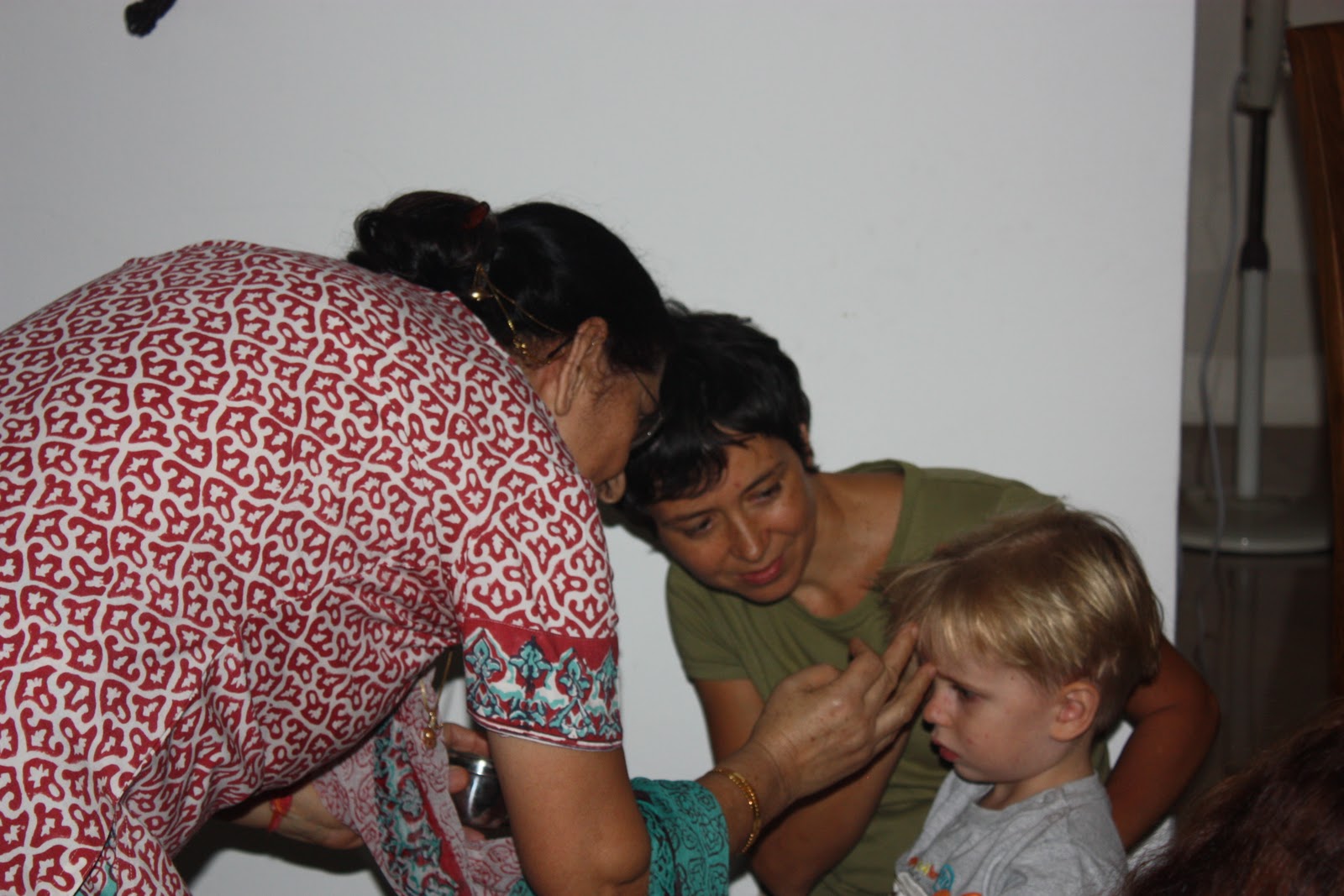
the kids listen to The Whirl Girl's grandfather tell them about the festival
each kid gets his/her feet washed
then they get a red "tikka" - a powdered dot in between the eyebrows
a nirvan (red ceremonial thread) is tied on the wrist of each of the kids
Then each of the kids received a small gift as a blessing. 

Finally it was time to eat!  There are foods traditionally made for the festival: puri (fried bread), kala channa (black chickpeas) and halwa (a sweet dish made from semolina).  It was a feast for the kids and their parents!  The recipe for halwa follows. 


Sooji (Semolina) Halwa
from the kitchen of The Whirl Girl's grandmother

Ingredients
200 g ghee
250 g sooji (semolina flour)
3 green cardamom pods, discard the pod and grind the seeds
3/4 cup sugar
2 cups water
slivered almonds for garnish

Directions
Heat the ghee in a skillet.  Once its hot, add the sooji and cardamom.  Then simmer on slow heat until brown, about 20-25 minutes.  Keep stirring. 

Add the sugar and mix in.  Add 2 cups water and stir until water is absorped.  Add more water if necessary.  Taste for sugar. 

Garnish with almonds.  Serve warm. 


Saturday, October 8, 2011

India language: शाबाश and मजा

Before picking our Indian words, we had to first pick our Indian language.  India has 18 official languages, many of which are totally dissimilar to each other in pronunciation and script.  Hindi is the most widely spoken, and it also happens to be one of the languages spoken in our home.  So we've picked two of our favorite Hindi words.

Maza (pronounced muh-zaa) means "fun."  The Whirl Girl has been using it since she was a little girl at meal times.  When there is something that she likes, she says maza and shakes her body in happiness.
Shabaash (shaa-baash) means "well done" or "great job."  A good one once you're done with a project!