Monday, October 10, 2011

Resource Monday: Growing Up Global

Every Monday, Whirls and Twirls features one of our favorite resources in global education, travel and/or creativity.

This week, we highly recommend:

Growing Up Global: Raising Children to be at Home in the World

Growing Up Global is a book by Homa Sabat Tavangar, and a complementary website with resources for exposing kids to the world beyond their borders.  

"Growing Up Global: Raising Children to be At Home in the World helps parents to raise children with a global perspective. Not all families can travel overseas to expose their children to world cultures, but they can start engaging with the world right in their own home communities. This hands-on book helps to begin that process."

I love the tone of the book.  It's a practical resource for parents that gives the how and the why of raising children to be global citizens.  It invites the reader to think of opportunities for cross-cultural dialogue in their home, neighborhood and community - and gives concrete suggestions of how to do so.  

One of my favorite features on the website is a resource called One World, Many Stories.  It's a guide with books and activities on a handful of countries, much like what we do here at Whirls and Twirls.

Sunday, October 9, 2011

India crafts: Flower Rangoli


Rangoli is a colorful design, often geometric.  It is usually done on the floor or courtyard of a home, using rice, grain or flour, or some kind of colored powder.  It's prominent during festival seasons in India, especially for Diwali.  It is used to welcome guests and gods/goddesses into the home.   You can find great examples of the variety of designs on this Diwali site. And Activity Village has a fantastic rangoli page with all sorts of ideas and printable outlines.

We used flowers to make our rangoli and we did it two ways: one indoor and one outdoors.

In Little India, there are street vendors selling flowers for puja (prayer ceremonies).  For a mere $2, we got a huge pile of jasmine, marigolds, roses, and orchids.  And between our indoor and outdoor crafts, we read Lily's Garden of India, one of our books for the month, which features Indian plants and flowers (including some of the ones we used). 


Supplies:
  •  printouts of rangoli designs like these
  • colorful flowers
  • glue (for indoor rangoli)
  • sidewalk chalk (for outdoor rangoli)


Indoor Rangoli

Step One: Pull the petals off the flowers and keep them in bowls sorted by color.  

Step Two: Put glue on one part of the rangoli design (I did this) and sprinkle flowers on top (The Whirl Girl did this). 

 Repeat with another design!

 Outdoor Rangoli

Step One: Draw a rangoli design.  I did some of the big shapes and The Whirl Girl added her own designs.

Step Two: Fill in with flowers.

Voila!  We were joined by some friends in the neighborhood, making it double the fun.  We'll probably make some more around Diwali time and invite more kids to join us.  


India field trip: Navratra Festival

This was a field trip that didn't involve leaving home, but rather bringing people to us!  

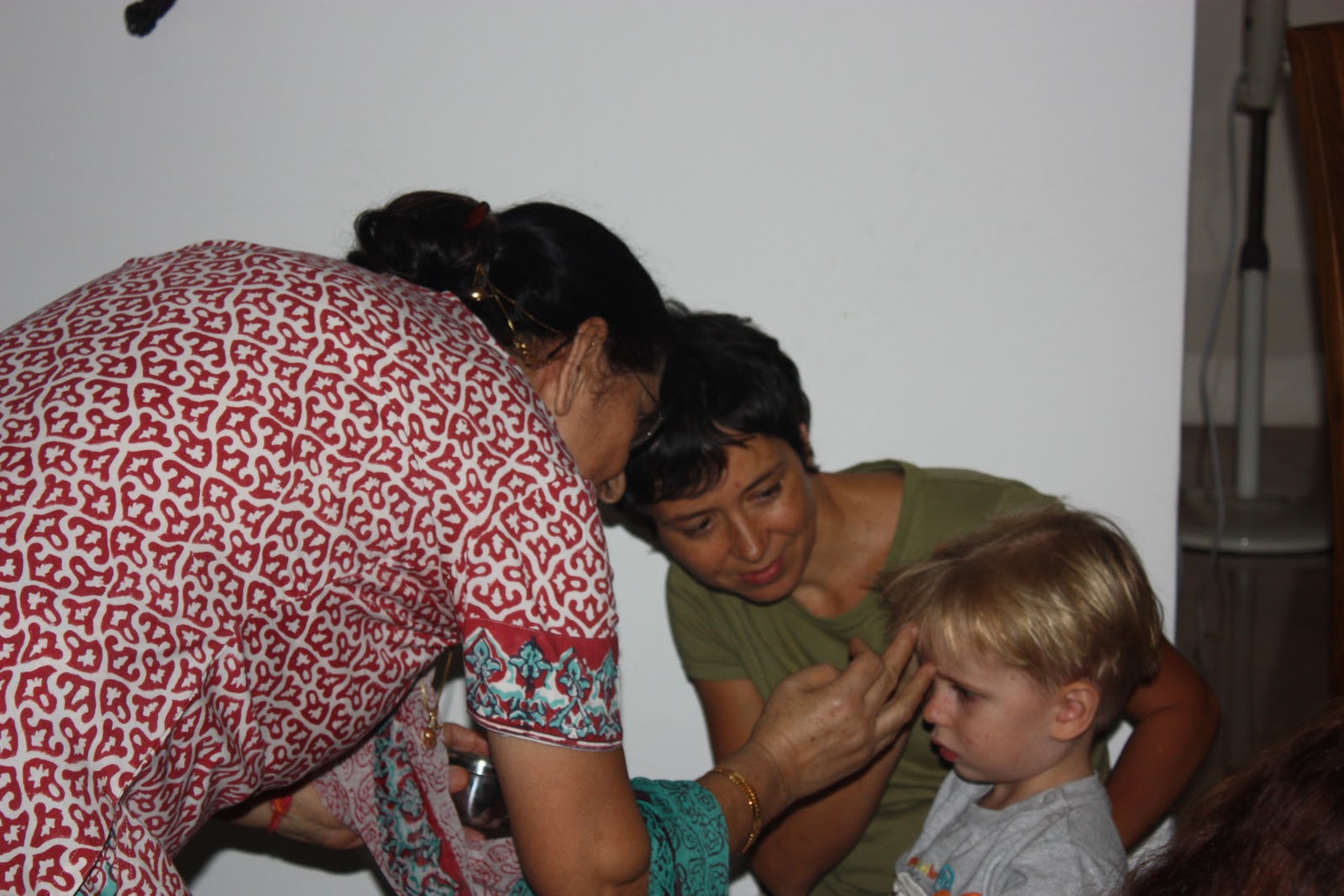
Navratra is a Hindu festival in honor of the goddesses Durga (power), Lakshmi (wealth), and Saraswati (knowledge).  Navratra means "nine nights" in Sanskrit and is celebrated for nine days, once in the spring and once in the fall.  On the eighth day in the fall, young girls are worshiped as goddesses.  In India, girls go from house to house and collect blessings and small gifts. 

We wanted to share the festival with our friends so we invited some of our neighbors over to celebrate with us.  And we wanted to be equal opportunity, so we invited the boys and the girls.

the kids listen to The Whirl Girl's grandfather tell them about the festival
each kid gets his/her feet washed
then they get a red "tikka" - a powdered dot in between the eyebrows
a nirvan (red ceremonial thread) is tied on the wrist of each of the kids
Then each of the kids received a small gift as a blessing. 

Finally it was time to eat!  There are foods traditionally made for the festival: puri (fried bread), kala channa (black chickpeas) and halwa (a sweet dish made from semolina).  It was a feast for the kids and their parents!  The recipe for halwa follows. 


Sooji (Semolina) Halwa
from the kitchen of The Whirl Girl's grandmother

Ingredients
200 g ghee
250 g sooji (semolina flour)
3 green cardamom pods, discard the pod and grind the seeds
3/4 cup sugar
2 cups water
slivered almonds for garnish

Directions
Heat the ghee in a skillet.  Once its hot, add the sooji and cardamom.  Then simmer on slow heat until brown, about 20-25 minutes.  Keep stirring. 

Add the sugar and mix in.  Add 2 cups water and stir until water is absorped.  Add more water if necessary.  Taste for sugar. 

Garnish with almonds.  Serve warm. 


Saturday, October 8, 2011

India language: शाबाश and मजा

Before picking our Indian words, we had to first pick our Indian language.  India has 18 official languages, many of which are totally dissimilar to each other in pronunciation and script.  Hindi is the most widely spoken, and it also happens to be one of the languages spoken in our home.  So we've picked two of our favorite Hindi words.

Maza (pronounced muh-zaa) means "fun."  The Whirl Girl has been using it since she was a little girl at meal times.  When there is something that she likes, she says maza and shakes her body in happiness.
Shabaash (shaa-baash) means "well done" or "great job."  A good one once you're done with a project!

Wednesday, October 5, 2011

India field trips: Little India

Singapore's Little India is sparkling with Diwali lights and humming with festival activity.  Though Diwali comes at the end of the month, there are a couple of festivals preceding it, and preparations for Diwali itself are underway.

Diwali is the Festival of Lights.  It celebrates the story of the Ramayana, and the victory of good over evil.  In India, it is an especially colorful and festive time.  There's some great background information and ideas for teaching kids about Diwali on the Gnaana blog.  We'll be putting some of them to use ourselves this month.

Our Little India has a Diwali market of its own, setting the mood for a month of celebrations.  Here's a taste of what we saw.  Check around and see if there's any decorations up in your favorite Indian restaurant or market!

the main road, lit up for blocks
firecrackers are a big part of the celebrations in India, and they find their way into the Singapore market too
bangles in all colors and sparkles
a stand selling things needed for devotional activities - coconuts, flowers, ghee, and fruits
diyas are candles that are lit on Diwali; oil/ghee is poured into these small clay vessels with a small string to create a candle
diyas come in all shapes and sizes
colorful decorations
peacock feathers!
namkeen, or Indian snack foods
mendhi (henna) artists provide lots of options for decorated hands and feet

colorful boxes

more colorful decorations


Monday, October 3, 2011

Resource Monday: Paper Tigers

Every Monday, Whirls and Twirls features one of our favorite resources in global education, travel and/or creativity.

This week, we highly recommend:

PaperTigers 

PaperTigers is a website, blog, and outreach program centered on multicultural young readers' books and reading as ways of fostering empathy, understanding and peace.

It has a wealth of book reviews, interviews with authors and an archived e-newletter centered around a theme related to multicultural children's literature.  For example, and particularly relevant to our travels this month, there was one last year on Children's Literature from India and the Indian diaspora.

PaperTigers also runs an outreach program, providing multicultural kid's books to communities in need around the world.


India crafts: Kick-off collage


It's collage time!  We start each month off by making a collage with pictures, the flag and a map of our new country.  (I use the same ones that I've posted on the itinerary).  I find that looking through the pictures is a great way to get The Whirl Girl excited and introduce the new place.  Then we keep it in her room with all of her Whirls and Twirls books.  For details on supplies and directions, check out the post on our Kenya collage.


For this month, I used some handmade paper from India for the letters.  I've included photos of it below, in case you want to print it out and use it for your own letters.