Friday, June 17, 2011

Kenya music: rhythm

For music, I wasn't sure what we could do besides play some Kenyan music in the background of our activities or find some music on YouTube. So I asked a friend who is a music educator for help. How to teach a little kid about music in a way that's fun and educational? As a high school band teacher and a mom of three young kids, she was full of ideas.

She suggested we look at rhythm, as a good intro to young music learners. Specifically we could practice the rhythm in Kenyan drumming: a pattern of Long, short, Long, short short short. I played the Long short Long rhythm and then asked the The Whirl Girl to repeat it back. Eventually we will add in the additional three shorts. It's a work in progress, but the most important part is that she's having fun doing it. A perfect use for our newly created drum!


Then, we checked out this video. It was hard for me to pick out the specific rhythm, but it definitely sparked The Whirl Girl's curiosity. She loved watching it and playing her drum at the same time.

The Whirl Girl has also enjoyed listening and dancing to the Putumayo African Playground CD that we have. It's a great mix of cheery songs that make it hard to sit still. Unfortunately the tracks aren't downloadable on the Putumayo site, Amazon or iTunes so you have to buy the CD.


Others I've been checking out are:

Smithsonian Folkways has an amazing collection, and you can purchase and download individual songs, as well as albums. And they come with some interesting background information.

And The Rough Guide to the Music of Kenya, with short sample tracks available for listening but also not available for download.

Check your local library, they might have them!

Wednesday, June 15, 2011

Kenya Language: Jambo!

Our word of the month for June is Jambo!

Jambo means "hello" in Swahili and we've found it everywhere! In the play we saw, when watching Tinga Tinga Tales, in books, and in songs.

Jambo Friends!

Kenya crafts: drums

For this crafts activity, we made an afternoon of it. We invited some friends to join in the fun as we made drums, listened to music and ate Kenyan peanut soup together! I also put our Kenyan books out so the kids could look at them.

For inspiration, I played an African music CD from Putumayo that I had. Though none of the music was from Kenya, it helped get us in the mood. There are one-minute sample clips online, but you can't download songs (or even the whole album). But you can download individual songs from Smithsonian Folkways, which has an amazing collection of world music, including Children's Songs from Kenya.

On to the drum making!

Supplies:

  • fabric - we used some of the cotton fabric that I have from Kenya (thanks to a traveling friend), but any would work. You could even use white fabric and paint it.
  • parchment paper
  • craft glue
  • rubber bands
  • a metal container - I bought small plant holders from IKEA for $2/each. You could also use an oatmeal tin (metal or cardboard)
Before the kids came, I cut the parchment paper into squares that were the right size to cover the top of the metal container (big enough to cover it and have some hanging over the sides to be held down by the rubber band). I also cut strips of fabric for decoration. I waited for the kids to come and let them pick from the fabrics for the top of their drum and then cut them in squares the same size as the parchment paper.

fabric choices

The first step was to glue the parchment paper to the fabric. I poured the craft glue on paper plates and then the kids used wooden chopsticks (easier to find in Singapore than wooden popsicle sticks!) to spread the glue around.


Then they stuck the fabric to the paper.


And finally, with the help of a parent, we put the fabric/parchment paper on the top of the metal container and wrapped 3-4 rubber bands around the top to hold the paper in place. And then we had ourselves a drum!


I had also cut out strips of cloth to be used as embellishments, which could have been glued around the base or threaded through the rubber bands. Our little ones didn't have much attention for it and were happy to have their finished drums, but older kids might be into more decoration.

Then, I put on this video of kids in Kenya dancing, drumming and singing. The kids had fun clapping and drumming along.

Sunday, June 12, 2011

Kenya cooking: Peanut soup and ugali

All this crafting was making us hungry! Time to cook up some Kenyan food.

We made Peanut Soup and Ugali, a cornbread porridge. Both turned out great and were gobbled up by The Whirl Girl, who can be a picky eater. We also made Cornbread Muffins, which were a good alternative to the ugali, though not quite as authentic. We invited some friends over to join us - just like in our book Mama Panya's Pancakes. It could be an easy weeknight meal and it keeps well for leftovers too.

The goal was to get The Whirl Girl involved in the cooking. She loves to mix and measure, so the cornbread muffins were the easiest for her participation. She also helped mix the cornmeal and water to make the ugali before I heated it. For the soup, she helped by piling the vegetables in a bowl after I cut them and then I took over the cooking. She also really liked saying ugali (who doesn't?).

Recipes for all three follow. Enjoy!

a measuring pro
mixing cornmeal with water for the ugali
a bowl of peanut soup
a kid's bowl of peanut soup and ugali (they paired well together, though an even heartier stew would be great with the ugali)
cornbread muffins

Ugali (Cornmeal Porridge)

(from Kenya Travel Ideas)

Ingredients:
1 cup cold water
1 cup yellow cornmeal (the Mexican flour ‘Mozerapa’ is a close substitute to the Kenyan flour)
1 teaspoon salt (optional)
3 cups boiling water

Serves 4 to 6

Put cold water in a medium-size saucepan, add cornmeal and salt, mixing continually. Bring to a boil over high heat, gradually stirring and slowly add 3 cups of boiling water to prevent lumps.
Reduce to simmer, cover and cook for about 8 minutes, mixing frequently to prevent sticking.
The ugali will be done when it pulls from the sides of the pan easily and does not stick. It should look like stiff grits.

You can serve ugali with everything from meat stew to sugar and cream. Your choice!

Peanut Soup

(adapted from All Recipes - I added more veggies, some authentically Kenyan and some not, and a little extra spice)

Ingredients:
2 tablespoons olive oil
2 medium onions, chopped (I pureed in food processor)
2 large red bell peppers, chopped (I pureed in food processor)
2 carrots, sliced
2 celery stalks, sliced
2 sweet potatoes, cut in 1" cubes
4 cloves garlic, minced
1 (28 ounce) can crushed tomatoes, with liquid
8 cups vegetable broth or stock
1 teaspoon pepper
1/4 teaspoon chili powder (optional - I didn't use since I was cooking for kids)
1 tsp cumin
1/2 tsp cinnamon
2/3 cup peanut butter (I used natural creamy)
1/2 cup uncooked brown rice

Heat oil in a large stock pot over medium high heat. Cook onions and bell peppers until lightly browned and tender, stirring in garlic when almost done to prevent burning. Stir in tomatoes, vegetable stock, pepper, and chili powder. Reduce heat to low and simmer, uncovered, for 30 minutes.


Stir in rice, cover, and simmer another fifteen minutes or until rice is tender. Stir in peanut butter until well blended, and serve.


Sweet Cornbread Muffins

(from my mom's recipe book)

Ingredients:
3/4 cup sugar
1/2 cup oil
2 eggs, beaten
1 1/2 cups all purpose flour
3 tsp baking powder
1/8 tsp salt
1 1/2 cups yellow corn meal
1 cup milk

Blend sugar and oil. Mix in eggs.

In separate bowl, mix flour with baking powder and salt. Add corn meal.

Blend dry ingredients with the creamed mixture alternately with milk.

Pour into a greased, floured 9" square pan or into muffin tins. Bake for 30 minutes in a 400 F oven (less for muffins - check after 20 minutes). If golden on top and toothpick cones out clean, they are ready.

Saturday, June 11, 2011

Kenya crafts: Baobab Trees

Inspired by the Under the Baobab Tree play, we created our own baobab trees. We put them in a corner, and now we can sit underneath and tell our own stories about Kenyan animals (using The Whirl Girl's stuffed animals as characters) or read our Kenya books.

Supplies:

  • a glue stick AND green and brown paper (we used a mix of construction paper and tissue paper - what we had on hand)
  • OR paints and paintbrushes
  • print outs of a baobab tree, we used the one from this site:

We did the painted ones first. Ours turned out like rainbow baobab trees. The Whirl Girl painted two of the outlined pictures, and then did one of her own on a blank piece of paper.


Then we did the glue-and-paper one. The Whirl Girl tore the paper into small pieces and then used the glue to stick it to the paper.


Then she picked some space on her wall to hang them.


Ta-da! Our own little baobab tree forest.


Monday, June 6, 2011

Kenya Field Trips: African Folk Tales

We went to see the Under the Baobab Tree play this weekend. The play was a collection of African folktales about animals, with a couple of songs and dancing mixed in. There were three actors, who changed from animal to animal, using a variety of costumes and puppets as their stories were told. It was quite interactive and the audience was asked to say "Jambo!" (hello) to each of the animals when they appeared. The Whirl Girl loved it, and it was especially fun that it reinforced some of what we've been reading in our books.


For those of you who can't or didn't see the show (or if you did see it, and want to revisit it), you can create your own version at home. All you need are a few stuffed animals, finger puppets, or even photos of animals. I don't know about you, but we have a bin of stuffed animals that often get forgotten and when I started rifling through them, I was pleasantly surprised to find that many of them live in Kenya. There were elephants, lions, giraffes, zebras, monkeys, hares and crocodiles, just waiting to be played with. Now they are characters for your own play.

Then you need some stories. Check out Tinga Tinga Tales (a new-to-me TV show) for very abridged versions of traditional stories like why the hippo has no hair, why monkeys swing on trees, and why the elephant has a trunk. A series of books by Mwenye Hadithi (aka Bruce Hobson) tell African animal stories for a young audience based on folk tales. And there's also books available with a number of African folk tales in one, like Nelson Mandela's Favorite African Folktales and A Pride of African Tales. We've not read them yet, so if you have, let me know what you think. Or make up your own! Why do you think the zebra has stripes?

And if you're really into it, make your own baobab tree. Here's a version that can be colored. And a photo for inspiration:

(photo from National Geographic):

Let the story telling begin!

Friday, June 3, 2011

And We're Off!

With the blog up and running, it was time to get The Whirl Girl involved. First on the list: get her as excited about the project as I am.


Step One: Where is Kenya?!

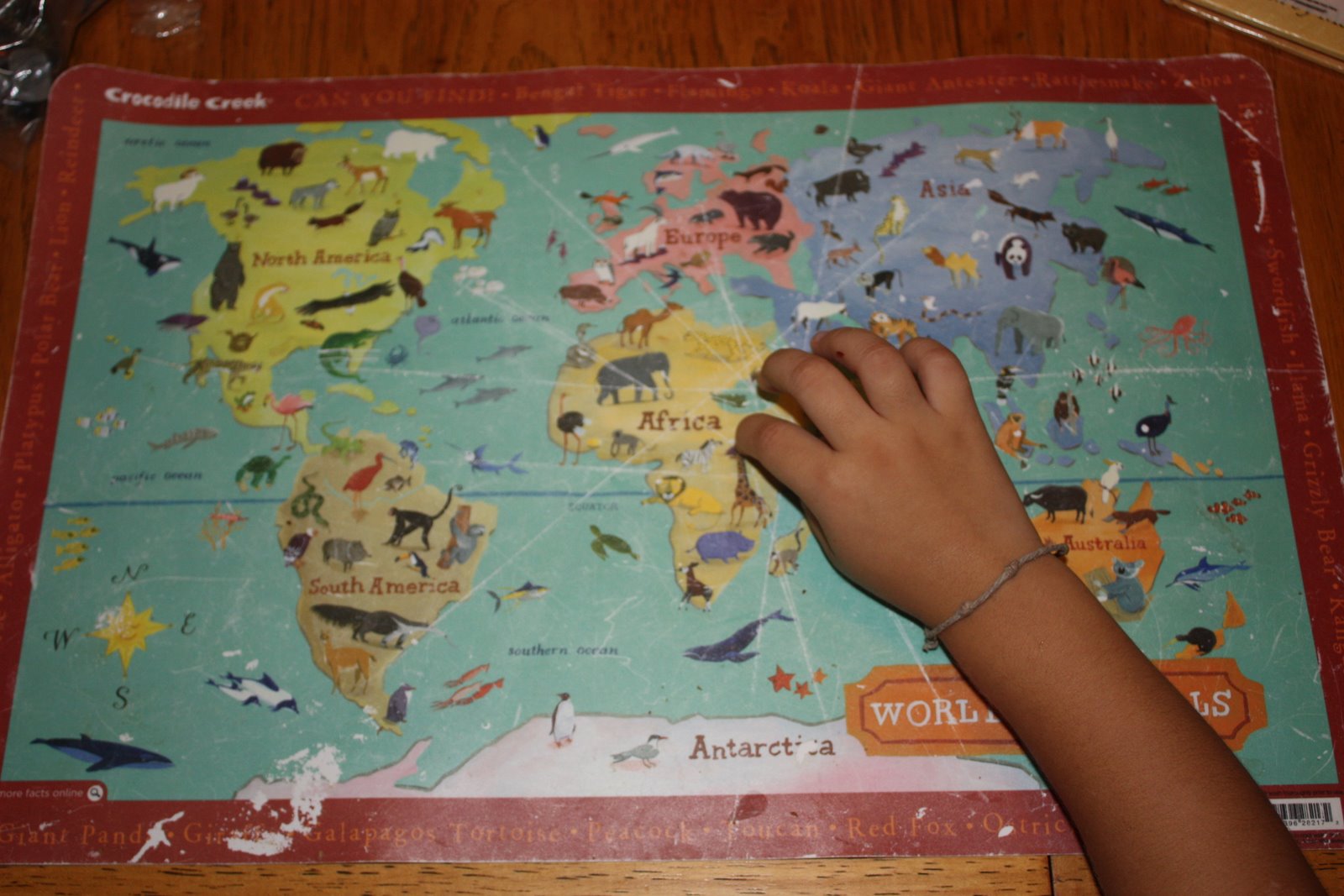
We have two maps that she already loves to look at and inquire about. So just before her afternoon snack, we took a peak and found Kenya on her placemat map.


Step Two: Creating a Whirl Twirl Space

I thought that to keep us both organized, it would be helpful to have a space to keep her books, crafts and other projects for the month. I put a file holder on her dresser and we'll decorate a sign each month with the name and photos of our destination.


And the trip has begun! Find more of our Kenya plans here.